California Bycatch
Overview
Bycatch is the term for fish or other marine life that are caught in a fishery but are not the target of the fishery. The unintended or unwanted bycatch is normally discarded overboard, often dead or dying. Bycatch is one of the most significant and preventable sources of human-caused mortality for California’s marine wildlife.
Campaign Victories
With over 350 victories globally, Oceana’s campaigns are delivering results. Explore the latest here.
Oceana has successfully campaigned to reduce bycatch across numerous state and federal fisheries in California, most recently securing the 2027 phaseout of the large-mesh drift gillnet fishery for swordfish, and state lawmakers approving legislation in 2025 to phase out the halibut and white seabass gillnet fisheries in future years. Together, these policy victories will protect whales, dolphins, sea lions, sea turtles, sharks, rays, and countless other marine animals from entanglement in fishing gear while advancing more sustainable fisheries.
Our current bycatch campaign focuses on the California halibut trawl fishery, which has one of the highest rates of bycatch in the nation.
Wasted Catch along the California Coast
California’s diverse and productive ocean waters are sometimes referred to as the “Blue Serengeti.” As a major feeding ground for large, highly migratory marine life like whales, sharks, seals, sea turtles, and tuna, it is a globally significant ocean region. The diversity of animals that migrate, feed, and reproduce in these dynamic oceans all share a common threat: the risk of becoming unintentionally caught — and often injured or killed — as bycatch.
In many cases, strong science informing targeted management measures can significantly reduce bycatch. For example, Oceana recently advocated for adding lights and other bycatch reduction devices on nets in the California pink shrimp trawl fishery. After those devices were incorporated in the fishery, bycatch of an endangered and important forage fish called eulachon dropped by more than 95%.
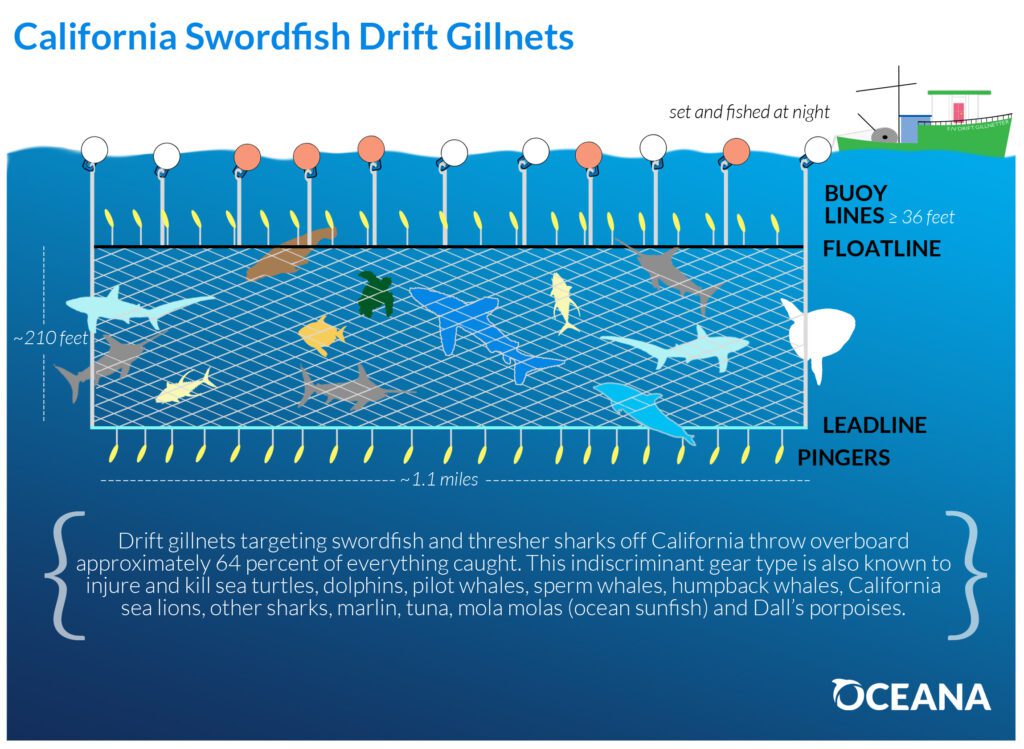
In some other cases, a switch to alternative fishing methods may be necessary to reduce bycatch while maintaining a productive fishery. For example, Oceana campaigned for years to reduce the bycatch of whales, sharks, and other wildlife taken in large-mesh drift gillnets off California. A key part of the solution was the development and adoption of deep-set buoy gear as an alternative way to selectively catch swordfish with dramatically less bycatch than drift gillnets.
Oceana is now focused on reducing bycatch in the California halibut trawl fishery. Federal data has shown that California halibut trawl nets ensnare 235 different species, including large numbers of Dungeness crab, giant sea bass (a protected species listed as critically endangered under the IUCN Red List of Threatened Species), a distinct population of green sturgeon (listed as threatened under the U.S. Endangered Species Act), sharks, rays, elephant seals, porpoises, and other fish and wildlife.
Measuring the amount of bycatch is difficult due to inadequate monitoring and reporting. Right now, California is wrestling with how best to measure bycatch levels in the state halibut trawl fishery and develop management measures to reduce those impacts. Oceana has been involved throughout that process, advocating for increased gathering and sharing of bycatch data and new management measures like time and area closures, limits on how long a trawl net can be towed, changes to net mesh sizes, gear modifications, and advanced monitoring and tracking of future activity, including bycatch.
Bycatch is also not just a California problem — it is a nationwide challenge that NOAA Fisheries identifies as a significant threat to protected species, including sea turtles, marine mammals, and seabirds. According to the most recent National Marine Fisheries Service National Bycatch Report Update (based on 2014–2015 data), U.S. commercial fisheries landed approximately 6.54 billion pounds of seafood while discarding an estimated 814.5 million pounds as bycatch. Reducing this waste and ecological stress through better science, improved monitoring, innovative fishing gear, and effective management is one of the greatest opportunities available to protect marine wildlife while supporting sustainable and economically resilient fisheries.
How to Reduce Bycatch

Oceana advocates for a three-pronged approach to reducing bycatch: Count, Cap, and Control. These principles can be incorporated into various policy arenas, including legislation and state or federal management measures.
Count everything and everything counts
Enhanced monitoring and tracking is necessary to ensure that species are not overfished, fishermen do not unintentionally exceed annual quotas, and that the industry adheres to sound management measures. This often requires scientific observers placed aboard fishing vessels to count and track all catch and bycatch. In some other cases, recent advances in electronic monitoring allow for cameras and other sensors to track catch and bycatch aboard vessels when a human observer may not be present.
Cap the amount of bycatch
Bycatch limits ensure that vulnerable species are not overfished and that depleted stocks can recover. These limits create strong incentives to avoid catching non-target species in the first place, reducing waste, preserving biodiversity, and supporting healthier, more resilient marine ecosystems. Bycatch caps have also prompted fishermen to come up with innovative gear modifications and real-time open-source reporting to avoid losing income due to the risk of fishery closures once a cap is exceeded.
Control the amount of bycatch
Bycatch can be controlled through a combination of smarter management and more selective fishing gear. These measures can include time and area restrictions that reduce interactions with vulnerable species, as well as innovative fishing gear such as excluder devices that allow non-target species to escape nets.
Reports and Fact Sheets
More About Bycatch in California Fisheries
Stay up to date with the latest news.